How Marketers Can Achieve Personalization at Scale, Part 1






The best marketing delivers personalized just-in-time-messaging that increases engagement. But a quick glance at your notifications shows how many of us are struggling to achieve even the most basic personalizations.
I’ve seen some bad marketing emails. This one is WAY up there on the list. #marketingfail #oops pic.twitter.com/J19MC92Bg3
— Steve Kiernan II (@SteveKiernan) June 22, 2016
At our recent DevGuild: Demand Generation event, we were thrilled to host Segment’s VP of Growth Guillaume Cabane for a presentation on programmatic approaches for capturing user data and personalizing a good user experience.
We’ve developed this two part guide from Guillaume’s talk and a follow-up interview to help you on your own personalization journey. Part one covers the foundational work that needs to be done to achieve meaningful personalization at scale. Part two will examine ways of applying the personalizations across multiple channels. We’ve also included some practical tips and resources to help you along the way.

Achieving meaningful 1:1 personalization isn’t easy, particularly when you want to do it across multiple channels at scale. Processes have to run smoothly in realtime across complex and disparate systems, and to keep costs reasonable, you have to achieve a high level of automation.
Add to this the reality that generic content and messaging is unacceptable and ultimately damaging to your brand. According to a 2016 study by Demand Gen Report, B2B buyers are spending more time considering new purchases before committing.
Are you still optimizing your messaging for the average user and not factoring in variations in your audience? Spray and pray tactics are bound to fail as irrelevant content will be ignored. This is true for startups that are just hitting their stride as well as large companies that are swimming in inbound inquiries.
The good news is that new cloud-based services are emerging that promise to bring better and more affordable personalization services to mainstream marketers.
Laying the foundation for a scalable personalization engine
1. Define actionable audience groups
To ensure your messages are relevant, you have to first figure out the best way to logically segment your customers, ensuring that the groups you choose can actually be targeted by your marketing automation solution.
A good place to start with segmentation is within the customer journey. Even if you have the luxury of a perfectly homogenous customer base, user needs vary based on where they are in the adoption process. Content that is relevant to a visitor who has just learned about your product is not likely to be helpful to them once they become your customer and are considering an upgrade.
At a bare minimum, you should segment based on where prospects are in their buying journey.
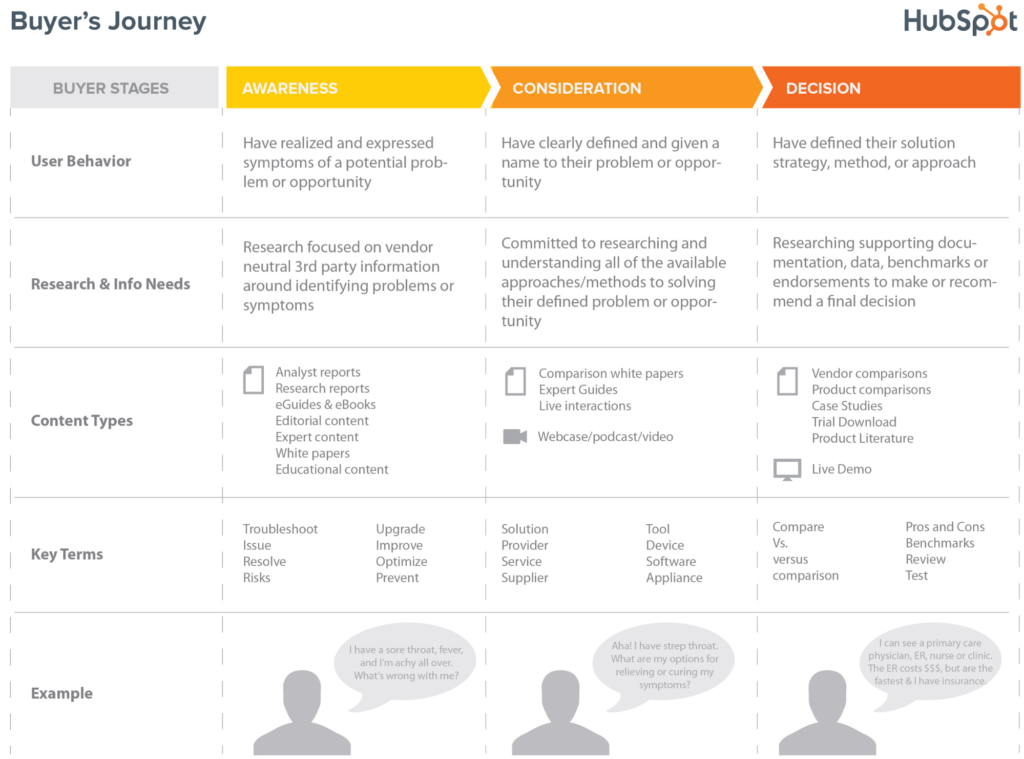
Once you’ve mapped out your customer journey, lead nurturing programs can then be designed to ‘nudge’ your customers through each stage or gate in the sales funnel.
In addition to the customer journey, it’s also a good idea to further segment your customers based on demographic data such as ‘males’ or behavioral data such as ‘on sign up’.
Depending on the size and nature of your company, you can develop one or many customer personas to guide your segmentation. As you’re developing your personas, keep in mind that they must work for the specific purpose of customer nurturing. Think about the characteristics of your audience that would help provide you with greater insight into how to best build a relationship with them. Then consider whether these characteristics can actually be tracked.
Resources:
How to build a customer journey map (Kissmetrics)
The Fastest Path To An MQL (Stormpath)
How to create a buyer persona (Kissmetrics)
Buyer persona template (HubSpot)
2) Identify Data Sources
Once you’ve figured out your customer journey and audience segments, you should look at what kind of data you need to track. During the data collection stage, try to take a channel-agnostic approach and focus on identifying your data sources.
- First Party Data: First examine the data you’ve collected based on your customers’ interactions with your company e.g. via your website. If you haven’t already, develop a tracking plan to ensure you’re collecting the right data.
- Second Party Data: And if the data you’ve collected is not enough, which is often the case, consider data sharing arrangements with companies you’re already working with.
Resources:
How to create a tracking plan (Segment)
Example of a tracking plan (Segment)
3) Explore Data Enrichment Options
Third party data has traditionally been of limited use to marketers because it’s typically anonymized and not available in real-time. But that’s changing. Today, services have emerged that allow you to enrich your customer profile for the specific purposes of reducing friction in your sales funnel and delivering more personalized messages.
Here are some practical ways to implement third party data enrichment into your sign-up workflow. Since these tools require a bit of technical know-how to set up, we’ve included benefits and metrics that you as a marketer can use to get buy-in within your organization.
Enrichment Example 1: How Segment reduced friction in their signup form to get 30% more signups
Are you losing prospects because your signup form is too long? Consider a multi-step signup form that utilizes Clearbit to remove friction:
- Create a multi-step form with the first step capturing an email address.
- Send that email to Clearbit immediately. The Clearbit API will return a JSON object that can be used to pre-fill the rest of the signup form in real-time.
- Show the user the information that you collected as pre-filled form options. If the user changes any data, Segment recommends that you take the safe approach and assume the entire dataset is bad. Store only the data the user confirms and discard the rest of the dataset.
- Use the info you collect from Clearbit to customize reinforcement messages and dynamic content e.g. if Clearbit data reveals that the user works in marketing, include a testimonial from another marketer as additional social proof.
Resources:
Check out Segment’s frictionless signup form here.
Want to implement this? Get the open source code here.
Enrichment Example 2: A predictive scoring model to identify high performance leads
If you’re getting loads of inbound leads but your sales team isn’t happy with the quality you’re passing along, you should look into automated lead scoring. Enrich your lead profiles automatically by connecting your CRM or Marketing Automation Solution with MadKudu’s predictive scoring service.
- Send your payload of prospect ID data from Clearbit to MadKudu. MadKudu runs the data through your branching model and returns a fit score (Firmographic Score) on a scale of 0 to 1.
- Once you’ve filtered your leads, you can provide tailored onboarding processes for each of them e.g. high-touch enterprise leads can be presented with the option to be contacted by a sales rep to get started. Lower spend leads can be sent through a self-serve process.
On implementing the scoring model above, Segment booking rates went through the roof, with 30% of top score leads requesting to be contacted by sales.
Resources:
Get additional details on predictive scoring here. (MadKudu)
Enrichment Example 3: Qualifying ‘visitors’ for outbound marketing efforts
What about the vast majority of anonymous visitors to your website who don’t disclose their email address? Here’s one way you can identify and score leads to support your outbound efforts. Note that this approach isn’t reliable if a visitor comes to your site on an internet connection with a shared public facing IP e.g. someone who works in a coworking space.
- For visitors who haven’t provided email addresses, do an IP lookup via Clearbit.
- Clearbit returns a probable domain and some technological details about the company, like what tools they currently use in their web stack.
- Send the details to MadKudu for your firmographic score.
- If the score is good e.g. >.9 then
- Get the roles & emails of relevant people via the Clearbit Prospector API & send them targeted emails.
Wrapping up
It’s important to recognize that while third party services offer compelling new opportunities, they also come with data quality issues. Adequate quality control measures have to be put in place to avoid embarrassing outcomes.
Pushing messages based on bad data is significantly worse than pushing generic content i.e. it’s better to send a ‘Dear User’ message than a ‘Dear Jack’ message to John. One workaround, as in the frictionless signup example above, is to design a workflow that gives the user the option to review and self correct your third party data.
The key to delivering 1:1 personalization at scale is hyper-segmentation. But to achieve this, you have to first lay the necessary foundation. Define your actionable audience groups and then aggregate data from different sources into a data-rich profile.
When your prospect and customer profiles include a wealth of buyer signals such as lead scores, behavior scores, persona and technological traits, you can really begin to slice and dice your segments and apply personalizations across your marketing channels.
Part 2 of this guide will focus further on how to deploy personalizations across your various marketing channels. If you’d like to be notified, sign up for our mailing list or follow us on Twitter.
Subscribe to Heavybit Updates
You don’t have to build on your own. We help you stay ahead with the hottest resources, latest product updates, and top job opportunities from the community. Don’t miss out—subscribe now.
Content from the Library
Building Contentful’s Global Advocacy Program
I recently attended a webinar put on by Vanilla forums that featured Alicia Taggio, Advocate Marketing Manager at Hootsuite, and CMX’s David Spinks. You can watch the full webinar or view the slides here, but I’ve also assembled a few takeaways below alongside some valuable insight from Contentful’s Director of Developer Relations, Ricardo Alcocer.
SaaS Content Strategy: Targeting & Measuring
If you put out a piece of content and can’t confidently name both the target and goal, you’ve failed. In a previous post I outlined the four basic tenets of a content strategy; objectives, targeting, measuring, and prioritizing. Let’s take a closer look at targeting and measuring.
SaaS Content Strategy: Are You Doing it Wrong?
Join us at DevGuild: Content Strategy – a half day conference featuring speakers from Stack Overflow, Auth0, Algolia, Twilio, Box and Intercom – and build a better content strategy.