Lessons From Five Years of Building a Technical Content Marketing Process
 Oleksii KlochaiPrincipal, Wizard on Demand

Here’s how we got the ball rolling on creating our technical content marketing process.
My technical content marketing agency started in 2018 without a formal process. (After all, the agency was just me at the time.)
But soon after starting, I added the first team member, and now we needed to share the work. A process was born.
Since then our team has grown and the process has evolved with us. You can read about how our process looks today in a recent article by Sarah Barber on the Wizard on Demand blog. In this article, I will highlight some of the things we learned on the way to the process we follow today.
Hopefully, if you are building an in-house technical content marketing team from scratch, or have recently taken over an existing content initiative, I can save you some trial and error and increase your chances of success with your technical content strategy.
What Is the Process of Content Marketing? (And How We Got Here)
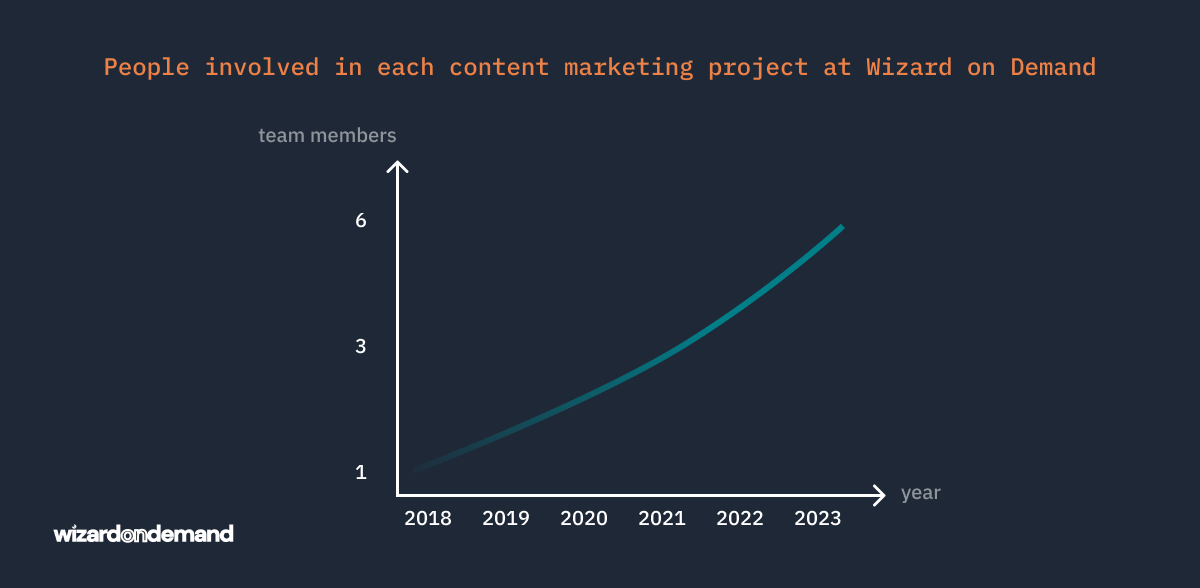
A chart showing an increase in the number of team members involved in each content marketing project at Wizard on Demand from one in 2018 to six in 2023.
The first team member to join us (or, well, me) at Wizard on Demand was our editor Dan. I am not a native English speaker, so having a native editor as the first hire was high on my list. Hiring an editor is still something I highly recommend, whether you’re a native speaker or not, but especially if not.
We then added more technical writers to the team. Over time, we introduced reviews in between writing steps. As we are dealing with technical articles that are quite complex in nature, we wanted some assurance that we weren’t missing details or letting mistakes slip through. I was looking for something between a peer review and a code review. Having a team of technical content writers made it possible for us to review each other’s work, checking the structure and the strength of arguments, validating the data, and providing feedback on tone and voice, before sending the final article for editing. The editor covered some of that as a second pair of eyes, and continued to focus on making the writing even better, as well as giving the writers pointers on how they could improve.
When we decided to step up our design game, we added a designer to the team, who now creates detailed technical illustrations and other creatives such as social media posts, product marketing materials, and ad campaigns.
The process grew organically as more people got involved. On top of the writing itself, we started tracking outcomes of our work for clients more directly and focusing on conversions, which added strategy-related work items to the mix.
Today, most articles that Wizard on Demand produces have been worked on by six different people. We learned a lot during this transformation from a single person to working as a team in five years. Here are my top learnings so far.
Lesson One: Care and Attention

We have learned that creating content that measures up requires us to become mind-readers.
When I first started, I thought a ”good” technical article meant a combination of error-free facts and good writing that’s enjoyable to read. I still think those aspects are both important. But our clients usually have a broader set of needs, and their honest feedback — which I welcome — is one of the reasons for our success.
“This just doesn’t hit the mark,” a CEO told me a few years ago on a call that we quickly organized after sending them the draft of a piece we did.
Strange, I thought. The article is error-free and is enjoyable to read! Surely the CEO is at fault for not communicating what they want? At this point I could have gotten philosophical and said, “Oh, it’s too hard to hit the mark for smaller clients that are creating new categories in the technology space. The knowledge that exists about their product is limited, not everything is written down, lots of details are in people’s heads rather than in easily-accessible knowledge bases, and the terminology is ambiguous.” The whole project could have been written off as too hard.
But when I thought about it more, I realized that small companies aren’t succeeding at content marketing exactly because of this problem. If it were easy to create content, they would have already done it. For Wizard on Demand to succeed, running away from the problem of not hitting the mark wasn’t going to help; we needed to tackle it head-on.
Our solution has been to become mind-readers. Kind of. In practical terms, this means asking questions before we start the writing process so that we gain an understanding of each client’s needs and expectations. Using our experience, we can now predict what might be important for a particular executive given their situation and the company’s stage in the technology marketing cycle. It’s not actually mind-reading; it’s more about observing industry patterns–which is particularly important for developer-first startups.
I can’t put “mind-reading” on the invoice, though, so it’s not directly a part of our service offering, but rather our approach to it. The best term I’ve found to describe it so far is “care and attention.” If we care a lot, making sure we fully understand our goals for the content, the type of stories that are appropriate to tell in accordance with the company’s messaging, positioning, and market size, when starting a flywheel of content marketing for a company, then things will be easier later on. And conversely, being careless in such situations, not taking the extra time and effort at the beginning to properly scope what stories to tell and how, and only doing what you’re being asked to do is, somewhat confusingly, almost certain to cause issues in the future.
Lesson Two: There Are Many Steps
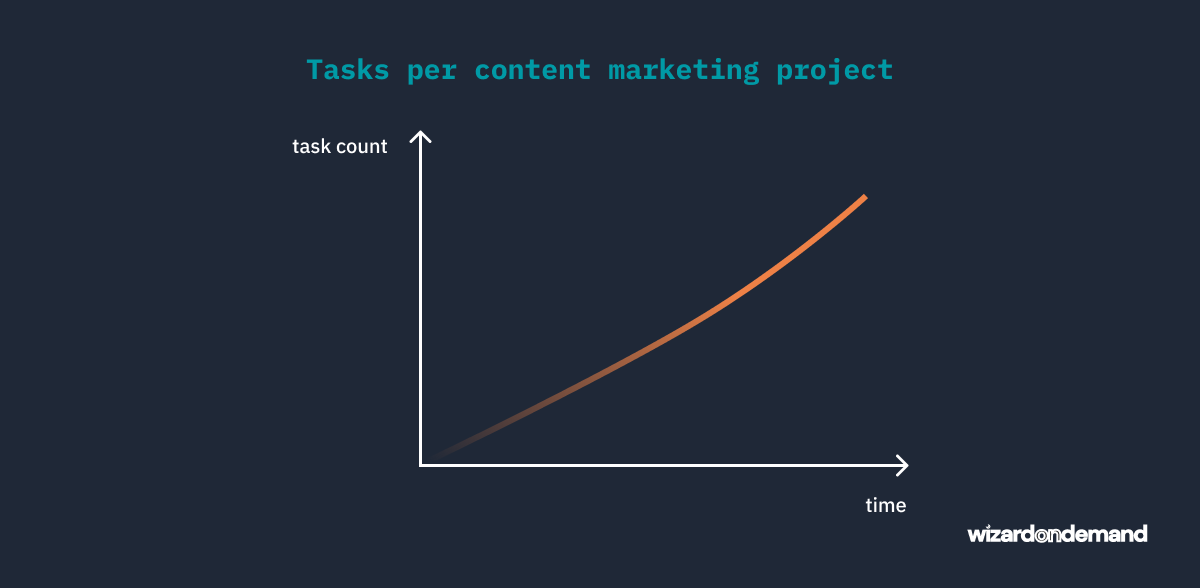
Over time, as you scale your content process, it’s common to see preparation and production tasks increase.
We always strive to make our work better, and this includes tweaking our writing process as well. One of the ways we get better is by bringing in additional expertise for specific parts of the process, such as adding an editor, a designer, or a strategist to the team.
The larger the team, however, the more effort it takes to keep everything organized. Something that was simply “working on an article” on my to-do list in 2018 became an Asana card with between 10 and 25 steps assigned to different team members today.
Sure, we are being a bit verbose with the tasks. Some of the things that we added as explicit steps are: Reviews at various stages, re-reviews if there are significant changes, editing, addressing editing feedback, receiving feedback from clients, monitoring SEO writing performance, creating header images, creating ad campaign assets, and sharing links with relevant newsletters.
On one hand, this explosion of steps makes keeping things organized a job in itself. Our project manager is instrumental in keeping everything together.
On the other hand, having more structure lets us work more predictably. We know who is working on what task and when it is due. We can work towards launch dates and know ahead of time what dates we can (and can’t) hit.
The takeaway here? I wish we’d had good project management sooner, and I wish we’d gotten explicit about all the steps earlier, even if the number of steps seemed huge.
Now that we have the steps laid out, we can reason about them and intentionally simplify—or replace—steps if we decide that we can do them better. We can also plan with relative certainty and get more visibility into team capacity, which we can’t do if the steps aren’t explicit.
Lesson Three: Opportunity Cost Exists
How do you currently decide what you’ll write about next?
If you are like most devtool startups, chances are that you have many ideas floating around, but they are seldom written down anywhere. And even if they are written down three levels deep into the marketing team’s Notion page, it’s not clear what topics have priority.
We originally addressed the prioritization question due to a simple reason: We charge dollars (or euros or pounds sterling) for our work, and marketers feel pressure to make sure they are spending well.
I believe we had a somewhat unfair psychological advantage here compared to in-house marketers. Marketers who don’t deal with budgets don’t feel such strong prioritization pressure, in my experience. Some of the most effective marketers I know, even if they don’t directly deal with budgets, create this pressure for themselves by translating team members’ time into currency and keep track of what they are “spending” and why they are spending it on one initiative versus another.
Besides being able to understand opportunity cost, tracking content marketing ideas and evaluating them consistently makes you less subject to recency bias. It can also help you resist pressure from leadership to abandon core topics in favor of jumping on whatever is getting the most hype at the moment.
To build the prioritization flow that we use with clients and internally for our own projects, we borrowed the product management Confidence Meter from Itamar Gilad. We consider three categories for each content marketing project that we can work on, and we assign a score between 1 and 5 to each item using these considerations:
- Estimated value of the outcome if we succeed: For example, if we expect a small yet consistent stream of conversions from a piece of content, it might be a 3. “Owning” an industry term might be a 5. And so on.
- Confidence that we can achieve success: Such as ranking the client’s site #1 for a particular keyword in Google via SEO or otherwise reaching our target audience. If we think we can do it but have no experience achieving such outcomes, it might be a 1 for confidence. If it’s a project that’s very similar to another one that we just finished and for which we have a lot of positive data, it might be a 5.
- Ease of implementation: Items score high if they are not a lot of work, and that applies both to content creation and distribution once they’re live. A couple of hours for an update to a small page that’s getting a lot of organic traffic could be a 5. Days or weeks to spin up a complex new page and then promote it using unscalable promotion methods might be a 1.
Once we have the scores, we multiply the values to get the total score, then rank projects starting with the highest score first.
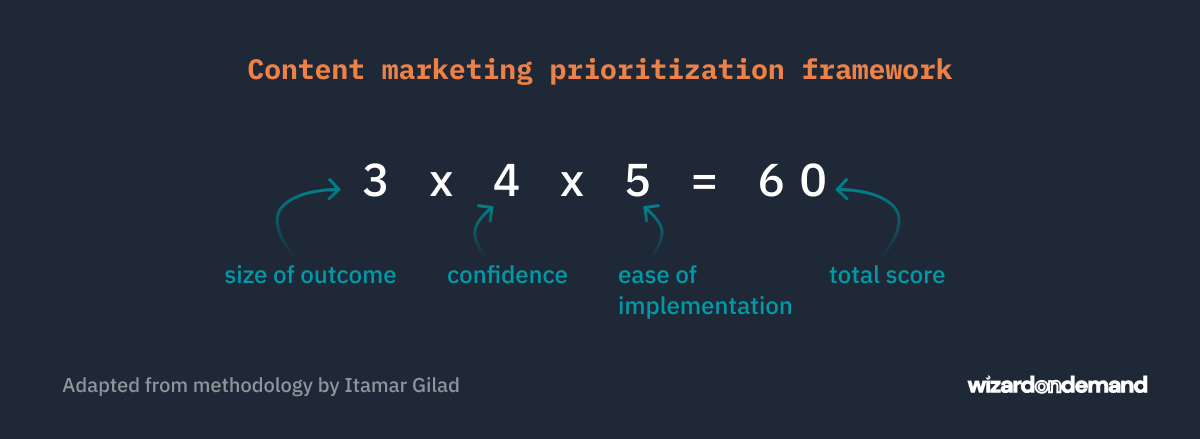
Wizard on Demand uses a three-part formula (outcome, confidence, ease of implementation) to score content projects: For instance, an article with a decent predicted impact (3), for which we are fairly confident (4), which will be easy to implement (5) gets a total score of 60.
To make sure our ranking methodology stays consistent, we write down a few examples of scores that we assign to particular items for future reference.
Today, we see that companies that have adopted a prioritization procedure have more confidence in their content marketing efforts across the board. There are also less-obvious benefits from prioritization: it forces you to consider distribution early on, and creates a feedback loop that helps you come up with better content marketing ideas for the future.
(Be right back—adding an article on the non-obvious benefits of prioritization to our ranked list of ideas...)
How Can Developer-First Startups Use Our Approach?
Here, we’ve covered a [possible] recipe for success in technical content marketing: Care a lot, so that what you write is worth reading. Be explicit about what it takes to do the work, so that it’s possible to organize your team’s capacity accordingly. And prioritize with a useful scale, so that you work on the right projects.
As you’ve probably inferred, we’ve found a way to fit our processes and scoring systems neatly into our project management tools–we recommend you consider doing the same. These tools are only in service of doing better work, though, and you can absolutely make progress without them, especially if you are only starting your technical content program.
More Resources
Content from the Library
Technology Marketing vs. Product Marketing: Which Is Right for You?
Learn how technology marketing can complement your devtool startup's product marketing while offering powerful business benefits.
Refreshing Developer Content to Maximize AEO/GEO
Content expert Karl Hughes offers actionable tips to update developer content to optimize it for GEO to appear in LLM searches.
Developer Content in the Age of AI
How should startups think about using content to reach technical audiences in the age of AI? Technical content expert Oleksii Klochai explains.