Predictable Pipeline Part 3: Messaging Strategy






Doug Johnson is Founder and Managing Director of ScaleUp, a firm that helps early-stage teams execute sales operations, produce actionable data, grow top-line revenue and implement sales as a permanent, high-expertise discipline within their companies.
In this 3-part series, Doug walks us through a workshop that he’s delivered to hundreds of early-stage companies and their sales teams to help build predictable pipeline and repeatable closing processes that target your most profitable market segments, driving you towards an increased valuation and de-risked growth strategy.
If you’re interested in doing the activities in the video, you can access the spreadsheet here.
If you’re early in your sales career, you probably haven’t developed your messaging and positioning muscle. Part 3 of Predictable Pipeline is important because it creates a framework for you to understand how you can improve the strength of your messaging versus just guessing at it. Your messaging strategy is essentially the words that are being said, who you’re messaging to, the cadence, the touch points, and the channels that you’re reaching out.
Messaging Framework
The framework is Direct impact vs Indirect impact. From the perspective of the prospect or buyer, the salesperson should be able to communicate on a spectrum whether it’s going to directly or indirectly impact my business.
I like to use electric transmission as an analogy. The more steps between the source and the receiver, the more opportunities for electrical loss and velocity loss. And so if you think about that from a sales perspective, the message that the sales rep communicates to a prospect gets lost along the way as it gets transmitted internally in that prospective organization.
You might be thinking about your messaging constantly but I can tell you, your prospect’s not going to lose sleep thinking about how they’re going to communicate the message to their manager. So it’s important to strengthen up the source of that conversation, which is your value proposition, as much as possible. A strong value prop will enable the rep and the prospect to communicate the direct impact, easily and efficiently.
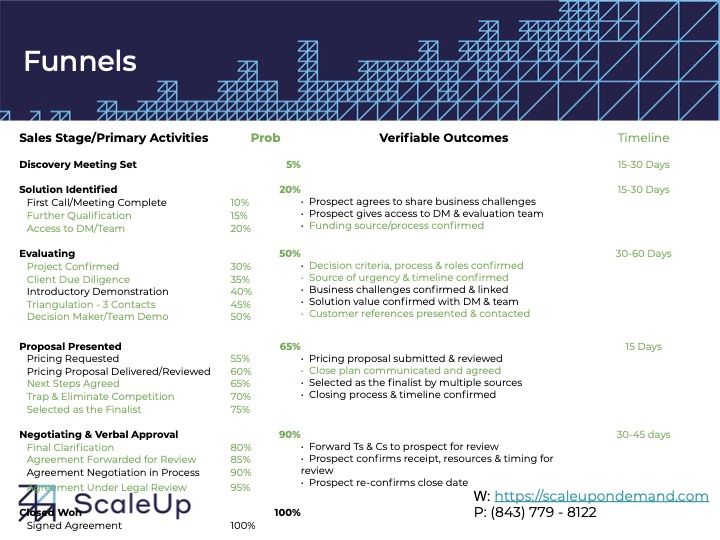
Direct vs Indirect
Think back to the electric transmission. Direct impact messaging will drive a shorter sales cycle and a higher win rate because there are less opportunities for miscommunication, and makes a financial statement right now. Indirect impact messaging makes a statement about financial impact in the future.
You might not be afforded the position right now to communicate how your product impacts revenue and cash. But there is a way for you to proxy and walk a prospect through how it’s going to lead to direct impact eventually. If you don’t help them understand, you’re putting the burden on them to do the calculations themselves.
They’re not going to do it unless they’re an early adopter of something and a strong advocate, and they understand the pain so well that it’s quantifiable, and they’re willing to pull in the decision maker. Otherwise you have to be the one to help them understand how they can connect the dots to direct impact. In short, don’t put the burden on them to understand how risk mitigation or saving time is going to translate into a benefit for the business.
In Practice
Identify the first market segment that you’re going to prospect and pick one of the personas from there. When you’ve picked your person, write down a feature or two features that would benefit them and describe the value proposition. You could say, it “increases customer satisfaction.” A better version of that would say, it “increases customer satisfaction by a x%.” And then go through an exercise of determining how it might impact them directly. What are the ways in which you can translate that to revenue or cash on a balance sheet or cost saved?
As you’re going through this activity, imagine that this will inform your messaging, your actual emails, what you talk about and prioritize in a phone call or a voicemail, or your LinkedIn message. If in the past, there’s been friction and objections or you haven’t been able to get prospects to respond to you, what we’re working on right now is going to help.
Frequency, Medium, and Duration
Here’s some guidance around the frequency that you’ll want to touch different personas and the duration of a cadence. Not all of these aspects change but it can change over time as the noisiness of different mediums and channels changes.
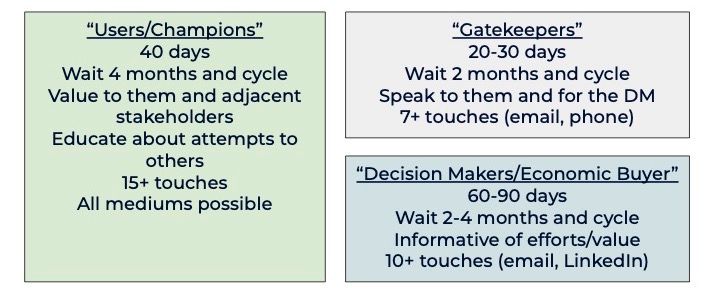
You’ll notice that the second sentence or bullet in each one of these is: waiting a period of time and then cycling them back through. Every one of these should be cycled back through a cadence again or put into a list where you’re providing them with some updates on the product or the marketplace you’re serving, or the pains or challenges that are in their environment.
It’s not a one-time thing. You wait, and can either put them through the cadence again, which is a rudimentary brute force way, or introduce a catch all place where you can keep in touch with them.
Ready for More?
Now that you have a better understanding of the strategy, how do you actually decide on the words that make up your messaging? Check out advisor and messaging expert Betty Junod‘s post on messaging to the user vs the buyer and see if you can apply what you’ve learned from Doug in the next exercise.
If you enjoyed Doug’s Predictable Pipeline 101 series and want to learn more, Doug offers a 102 workshop on Repeatable Closing: How to effectively build and manage the sales team. To work with ScaleUpOnDemand or inquire about participating in the workshop, reach out to Contact@ScaleUpOnDemand.com or on LinkedIn.
Subscribe to Heavybit Updates
You don’t have to build on your own. We help you stay ahead with the hottest resources, latest product updates, and top job opportunities from the community. Don’t miss out—subscribe now.
Content from the Library
Predictable Pipeline Part 2: Metrics and the Stack
In Part 2 of the Predictable Pipeline series, Doug Johnson walks us through metrics to track and be mindful of, and the tools in his recommended sales stack.
How to Think About Selling AI Products
EverWorker CRO John Roberts explains why there might only be one way to consistently sell AI products to human beings.
Generationship Ep. #52, Serendipity as a Service with Piyush Agarwal
On episode 52 of Generationship, Rachel Chalmers sits down with Piyush Agarwal to explore how developer behavior reveals far more about buying intent than traditional sales signals. They discuss why most dev tool GTM strategies fail, how to distinguish curiosity from real demand, and what it takes to engage developers at exactly the right moment.