The SCQA Framework in Action


One of our favorite talks in the Heavybit library is Michael Dearing’s talk on Executive Communication. Michael gives a great explanation of Barbara Minto’s SCQA framework for streamlined, clear communication. But at first glance, the highly structured format might feel a little rigid.
Both during and after the session, we heard a lot of great questions from the audience about using SCQA framework in the real communications. As Michael said during his talk, “There’s all sorts of ways to stretch and morph [SCQA] to make it feel like it’s culturally appropriate for you, but don’t lose the underlying structural value that saves your colleagues tremendous time trying to figure out what’s in your head.”
To highlight how the SCQA framework can be used as a tool to improve communication in a variety of less straightforward formats, here are a few examples of SCQA in action discussed during the session (as well as a few more examples from Twitter).
Using SQCA Framework to Outline a Story
Content marketing is at the core of many companies’ strategies, but writing clear, high-quality content can be a challenge for many teams. Using SCQA as a storytelling framework can help you draft everything from case studies to blog posts to changelog updates in an organized manner. Michael pointed out that he often teaches Robert McKee’s storytelling framework alongside SCQA. He contrasts the two techniques: “I think for [Minto], the purpose is, ‘Resolve a business conflict.’ For storytelling, the purpose is, ‘Have an emotional moment. Have a have a nice drawn out artistic experience.’”
These two purposes don’t have to be at odds, however. Even if your end goal is to create a compelling narrative, your readers will still benefit if you start with a clear, organized structure. Try using the SCQA framework as a tool to create outlines for all lengths of content ensures that your narrative is tight and focused.
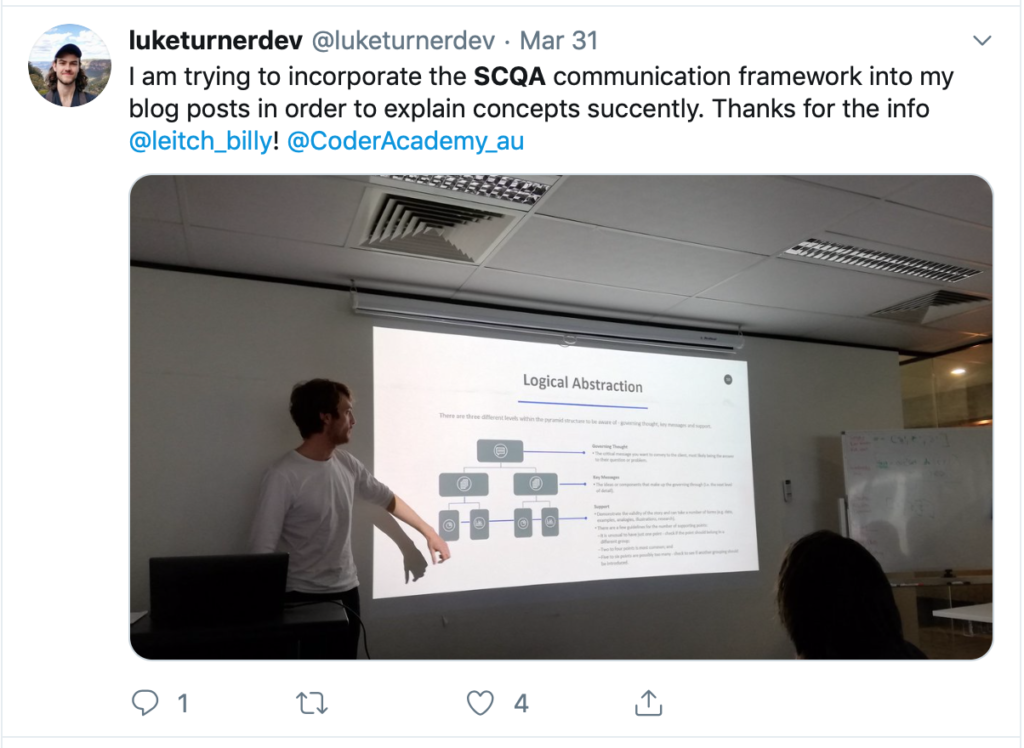
Image Source: https://twitter.com/luketurnerdev/status/1112249404411379712?s=20
SCQA for Troubleshooting Problems as a Team
The SCQA framework is certainly useful for one-to-one or one-to-many communication around a plan of action, but it can also be useful when you have no idea what to do — especially as a group.
Michael Dearing drew attention to this use case during the session: “By explicitly building it into the SCQA, and to invite [collaborators] and to say, ‘Here’s my draft, here’s my prototype A, but we have to iterate this together. If you want to get together, I’m going to carve out some time. If you want to do that I can rework some of these points and come back to you.’ There’s all sorts of things you can do to the SCQ and the A to make it a lot more palatable to colleagues.”
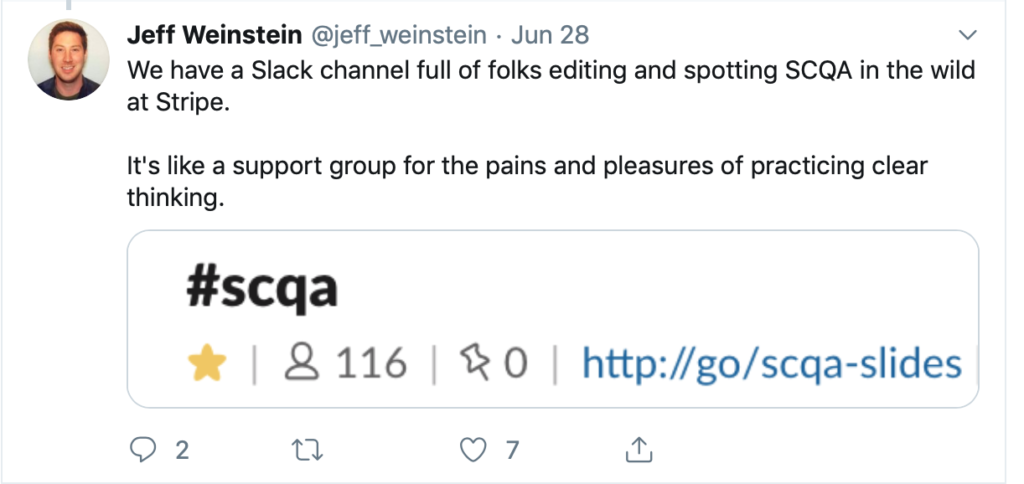
Image Source: https://twitter.com/jeff_weinstein/status/1144633225198764032?s=20
SCQA for Crafting Effective TL;DRs
An audience member at the talk asked if there were limitations to the format. Michael conceded that in some very short-form communications — such as quick conversations or Slack messages — the full framework might be overkill. But by becoming familiar with the format, you can use it piecemeal to craft succinct answers when you need to be brief, but clear. He explained:
I think there are some short form interactions where it’s tough to be full-Minto. A quick passing conversation, the classic example is ‘What’s the elevator pitch version of this?’ Imagine we’re in the elevator and I say, ‘How’s watches going?’ Are you going to stand there like a business robot and say, ‘As you know, business watches is 15% of our business and a gateway category for jewelry and shoes.’ No, you’re going to flex it and you’re going to say the elevator pitch version of this, which probably stops at ‘C’ or ‘Q.’
In those very quick interpersonal real-life interactions, you might stop at ‘Q’ and say, ‘If that’s something you’d like to go deeper on, just drop me a note. I’ll come by and show you some of the data we’re using to figure out what to do about it.’ It’s totally OK to break it up into pieces and to pick a form factor for the delivery, the ‘A,’ that’s really appropriate given the scope of the ‘A,’ or the complexity of the “A.”
For more on this use case, check out Stephanie Omolu’s Medium post on Learning to Pitch with the SCQA technique.
Learn More about the SCQA Framework with Michael Dearing
To hear the story of the SCQA framework’s origin, why it’s useful, and examples of how to implement it, be sure to listen to the recording of Michael Dearing’s talk on Executive Communication at the Heavybit Clubhouse.
Subscribe to Heavybit Updates
You don’t have to build on your own. We help you stay ahead with the hottest resources, latest product updates, and top job opportunities from the community. Don’t miss out—subscribe now.
Content from the Library
How to Orchestrate Multiple Agents from the Terminal
Open-source creator Gaurav Gosain explains how his work with terminal multiplexers led him to build multi-agent orchestration.
Long-Horizon Agents, Part 2: Memory Is More than Recall
Agents need persistent memory to become performant for long-horizon jobs. Amir Zohrenejad surveys the state of agentic memory and covers what’s missing.
Is the Key to Understanding Code Treating it as a Graph?
Treating software as a graph may be the key to quickly understanding and maintaining software in the age of AI. Open-source creator Vitali Avagyan explains.